Special offer! Comprehensive professional teeth cleaning for only 1699 UAH.
Special offer! Comprehensive professional teeth cleaning for only 1699 UAH.
Special offer! Comprehensive professional teeth cleaning for only 1699 UAH.
Special offer! Comprehensive professional teeth cleaning for only 1699 UAH.
Special offer! Comprehensive professional teeth cleaning for only 1699 UAH.
Special offer! Comprehensive professional teeth cleaning for only 1699 UAH.
Special offer! Comprehensive professional teeth cleaning for only 1699 UAH.
Special offer! Comprehensive professional teeth cleaning for only 1699 UAH.
Special offer! Comprehensive professional teeth cleaning for only 1699 UAH.
Special offer! Comprehensive professional teeth cleaning for only 1699 UAH.
Sign up
 (044) 394 90 94
(044) 394 90 94  Holosiivska/Demiivska metro station
Doctors


 Prices
Blog
Contacts
Prices
Blog
Contacts
пр.Лобановського, 130, Київ, Україна
Temporarily closed
Opening soon
78A, Irpinska St., Kyiv, Ukraine
Temporarily closed
Opening soon
32A, Heroiv Dnipra St., Kyiv, Ukraine
Temporarily closed
Opening soon
9B, Yevhena Chykalenko St. (Pushkinska), Kyiv, Ukraine
Temporarily closed
Opening soon
Sign up
En
(044) 394 90 94
Back
Dentistry
General Dentistry
Dental surgery
Dental Implants
Maxillofacial Surgery
Dental prosthetics
Cosmetic dentistry
Professional Dental Hygiene

Periodontics
Orthodontic dentistry
Gnathology & TMJ Therapy
Pediatric Dentistry
Dental X-Rays
Back
Orthodontic Center
Orthodontic dentistry
Gnathology & TMJ Therapy
Back
Prosthodontic Center
Dental prosthetics
Back
MED-DEO Center for Maxillofacial Surgery & Facial Plastics
Maxillofacial Surgery
Plastic surgery
Back
Surgical Dental Center
Dental surgery
Dental Implants
Search on the site


Popular requests
Teeth whitening
Treatment of caries
Wisdom tooth extraction
Bracket system
Dental veneers
Tooth restoration
Pediatric dentist
Consultation with a dentist-therapist
Search results by: «».
Unfortunately, no results were found for your search: “Pediatric Endocrinologist”, nothing was found.
You may find these links useful:
Clinics "MED-DEO"
пр.Лобановського, 130, Київ, Україна
Temporarily closed
Opening soon
78A, Irpinska St., Kyiv, Ukraine
Temporarily closed
Opening soon
32A, Heroiv Dnipra St., Kyiv, Ukraine
Temporarily closed
Opening soon
9B, Yevhena Chykalenko St. (Pushkinska), Kyiv, Ukraine
Temporarily closed
Opening soon
Services
Dentistry Orthodontic Center Prosthodontic Center MED-DEO Center for Maxillofacial Surgery & Facial Plastics Surgical Dental CenterGeneral Dentistry
Dental surgery
Dental Implants
Maxillofacial Surgery
Dental prosthetics
Cosmetic dentistry
Professional Dental Hygiene
Periodontics
Orthodontic dentistry
Gnathology & TMJ Therapy
Pediatric Dentistry
Dental X-Rays
Orthodontic dentistry
Gnathology & TMJ Therapy
Dental prosthetics
Maxillofacial Surgery
Dental surgery
Dental Implants
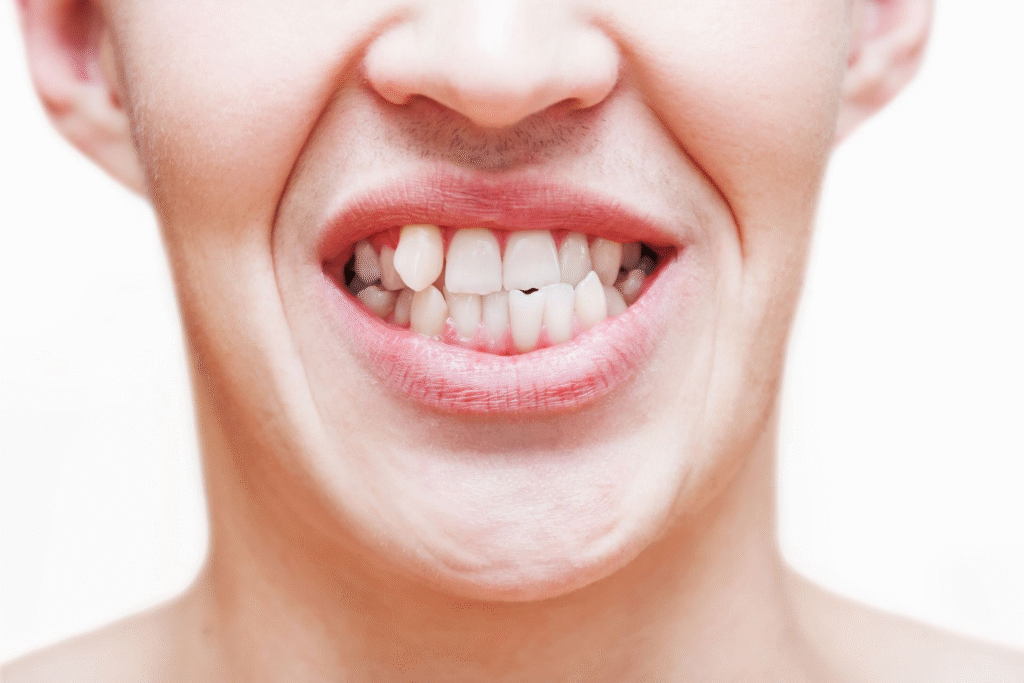
Many people pay little attention to a crossbite for a long time, but the problem goes beyond aesthetics. This type of malocclusion places uneven stress on the teeth, which can cause discomfort when chewing and even facial asymmetry. The question of how to correct a crossbite is therefore not merely cosmetic but also functional. Treatment depends on age, bite type, and the severity of the misalignment: in children, appliances, braces, or aligners that guide the teeth and jaws into the correct position are often effective, while adults frequently require a combination of orthodontic methods and additional procedures or, in complex cases, surgery. The key is to consult an orthodontist in a timely manner to develop an individualised treatment plan and achieve a stable result.
What Is a Crossbite?
A crossbite is not simply “crooked teeth” but a malocclusion in which the teeth — or even the entire lower jaw — shift laterally relative to the upper jaw.
Normally, the upper teeth slightly overlap the lower teeth on the outside. In a crossbite, some teeth close the opposite way: the lower teeth protrude outward while the upper teeth seem to “collapse” inward — creating a scissors-like effect.
As a result, the jaws do not function as they should: the load is distributed unevenly, chewing may be uncomfortable, tension builds up in the joint, and facial asymmetry gradually develops.
How a Crossbite Looks: Key Signs and Photos
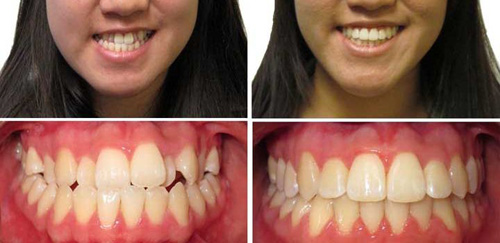
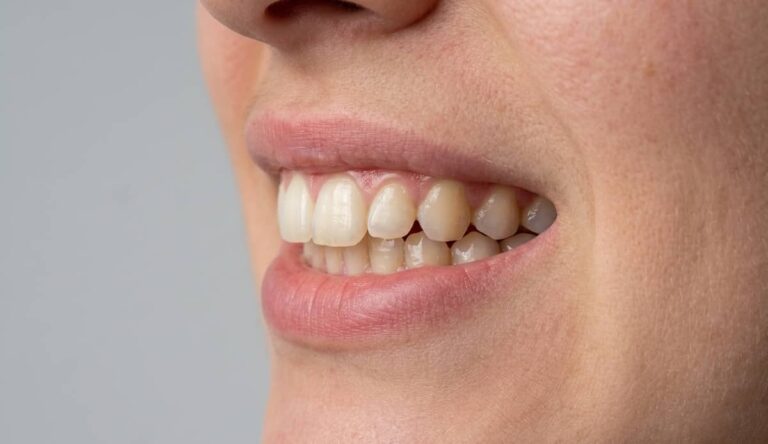
A crossbite can often be noticed without professional help — especially when looking carefully in a mirror or at a photo. Usually the first “hint” is not the teeth themselves but a general impression: the smile looks slightly uneven, the chin may be shifted to one side, and the lower face may not be entirely symmetrical.
When examining the bite closely, it becomes apparent that the teeth are not positioned as they should be. In a normal bite, the upper teeth slightly overlap the lower teeth on the outside; with a crossbite, some teeth seem to switch places — the lower teeth protrude outward while the upper teeth move inward. This may be visible on one side only, or on both sides.
Photographs can help draw attention to the problem — especially when comparing smiles from different angles. However, it is important to understand that photos can only raise suspicion of a crossbite. A clinical examination by a dentist is required to determine exactly what is happening and how pronounced it is.
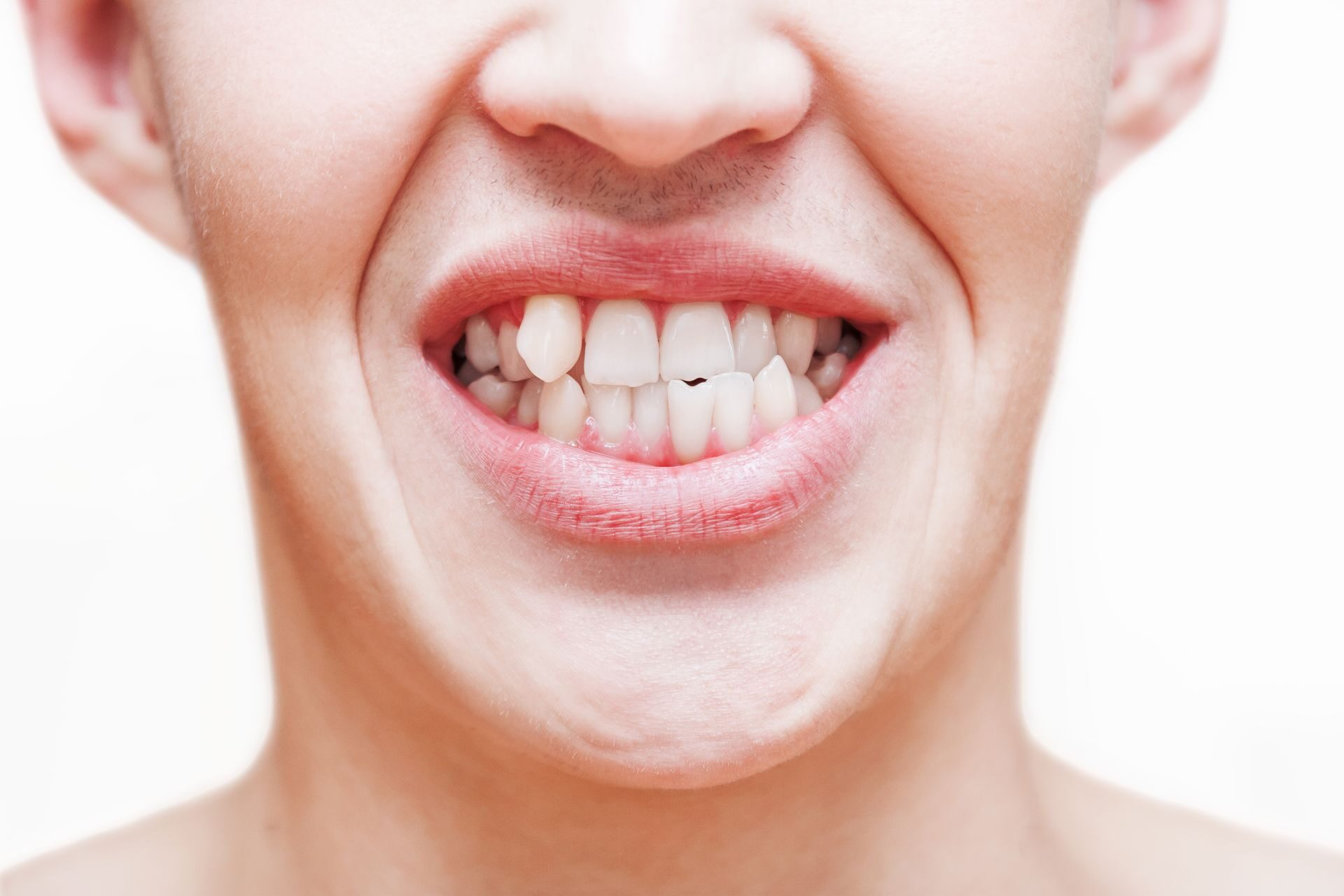
Lateral Shift of the Lower Jaw
A common symptom is the lower jaw shifting slightly to the left or right when the teeth come together. A person may not be consciously aware of this, but it becomes visible in photos or videos.
A lateral jaw shift is usually associated with a unilateral crossbite. To allow the teeth to meet at all, the jaw automatically moves into a more comfortable position. Over time the body adapts, and this displacement can become permanent.
The problem is that the load becomes unevenly distributed: one side works harder while the other works less. This can lead to discomfort, clicking, or tension in the temporomandibular joint. Even a small shift is therefore a signal that should not be ignored.
Signs in the Oral Cavity and on the Face
Signs of a crossbite can be conveniently divided into two groups — those visible from the outside and those noticeable when examining the teeth.
Externally, the most common signs include:
- Facial asymmetry, particularly in the lower third of the face
- A chin shifted to one side
- An uneven or “skewed” smile
- Sometimes a difference in facial expression on each side
Inside the oral cavity, one may notice:
- Some lower teeth positioned outside the upper teeth
- A “crossed” bite — the teeth appear to close incorrectly over one another
- A sensation that the teeth do not close fully or comfortably
- Discomfort when chewing, especially on one side
An important point: symptoms may be mild, especially in the early stages. Even minor changes can intensify over time. If any of the above resonates with you, it is best to have your bite checked to understand the situation and avoid letting the problem progress.
Types of Crossbite
A crossbite can present in different ways, and the type of anomaly determines how an orthodontist will plan treatment. Not all cases are alike: some people have issues only with the front teeth, others with the back teeth, and sometimes the displacement occurs on one side only or on both. The orthodontist’s first task is therefore to determine precisely where and how the teeth are closing incorrectly.
Anterior, Posterior, Unilateral, and Bilateral
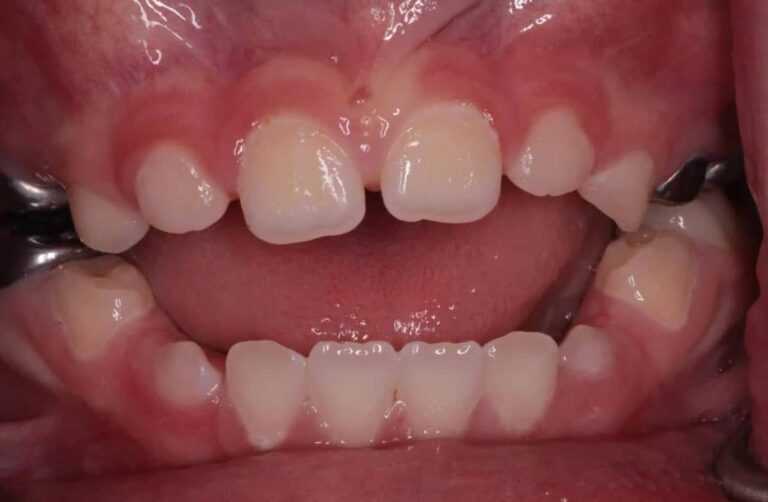
To identify the type of crossbite, the clinician assesses the position of the teeth. If the front incisors close incorrectly, the condition is called an anterior crossbite. Issues involving the lateral teeth, molars, or premolars are referred to as a posterior crossbite.
It is also noted whether the displacement occurs on one side or both. In a unilateral crossbite, the problem exists on one side only, and the lower jaw often shifts slightly to that side so the teeth can meet. In a bilateral crossbite, the abnormality is present on both sides: the jaw shift is less noticeable, but the bite is still incorrect.
Buccal, Lingual, and Mixed
This classification describes the direction of tooth displacement. When the lower teeth protrude outward toward the cheek, the condition is a buccal crossbite. When the upper teeth shift inward toward the tongue, it is a lingual crossbite. A mixed variant also exists, in which some teeth protrude outward while others shift inward.
Simply put, the difference between types of crossbite lies in where and in which direction the teeth are displaced. This determines which correction method the orthodontist will choose and how long treatment will take. Accurate identification of the bite type allows for an effective plan and a stable outcome.
Causes of Crossbite
A crossbite does not develop without reason — there are always specific underlying causes. It can be seen as a signal that the dental and jaw system is not functioning correctly. It is important to understand that treatment should address not only the bite and the misaligned teeth but also the factors that caused it. Otherwise, the problem may return even after lengthy treatment.
Congenital and Hereditary Factors
Some people have a genetic predisposition to malocclusion. This may manifest as uneven jaw growth or a specific shape of the dental arches that prevents the teeth from settling into their proper positions. Even with regular oral hygiene, the bite may remain incorrect. The clinician therefore always considers hereditary factors and the characteristics of bone and tooth development.
Causes in Childhood
In children, a crossbite often develops due to behavioural and physiological factors. Habits such as thumb-sucking or habitually pressing the tongue between the teeth can shift the teeth. Prolonged use of a bottle or dummy also affects jaw shape. Mouth breathing plays a particular role: when a child breathes through the mouth rather than the nose, the jaws grow differently and the teeth settle into incorrect positions. In addition, early loss of primary teeth or problems with the eruption of permanent teeth can disrupt normal occlusion.
Causes in Adults
In adults, a crossbite often develops as a result of jaw injuries, tooth loss, or errors in prosthetic work. Temporomandibular joint dysfunction may also be a contributing factor — when the jaw moves incorrectly, the teeth adapt to the new position and the bite changes. In such cases, simply straightening the teeth with braces is insufficient: the underlying cause must be addressed first, otherwise the teeth will shift back into an incorrect position over time.
A crossbite is not merely a cosmetic concern. It signals that the dental and jaw system is functioning incorrectly, and achieving a long-term treatment outcome requires addressing the root cause rather than masking the symptoms.
Risks of Leaving a Crossbite Untreated
At first glance, a crossbite may appear to be only a cosmetic defect, but its consequences develop gradually and accumulate over time. Initially, there may be mild discomfort when chewing or a sense that the teeth close uncomfortably.
If left untreated, the load on the teeth is distributed unevenly. They begin to wear down more quickly, and chips and cracks appear. The jaw often shifts laterally to “compensate,” gradually making the face asymmetrical.
Another significant consequence is overloading of the temporomandibular joint. The constant jaw displacement can cause pain, clicking, or a feeling of fatigue in the jaw, and sometimes even headaches.
In other words, a crossbite is not simply an aesthetic issue. If left unaddressed, mild discomfort can develop into serious problems for the teeth, jaws, and appearance.
Diagnosing a Crossbite
Many people mistakenly believe that a crossbite can easily be identified from a photo or a mirror, but in reality the matter is far more complex. External signs can suggest that something is wrong, but only an orthodontist can see the full picture during a professional examination.
During diagnosis, the clinician assesses how the teeth close, whether there is any jaw displacement, and how evenly the load is distributed during chewing. This makes it possible to determine whether individual teeth are simply mispositioned or whether the problem is more serious — for example, a jaw development disorder or temporomandibular joint dysfunction.
To obtain the most accurate picture, additional examinations are often carried out: X-rays, panoramic images, or 3D scans. These help assess the shape of the dental arches, the position of the jaws, and the interaction of the joints. Based on this data, the orthodontist determines the type and severity of the crossbite and draws up an individualised treatment plan.
Photographs and personal observations can only raise suspicion, but an accurate diagnosis and safe treatment require a professional examination by a dental orthodontist. This ensures that the outcome is precise, effective, and stable for many years to come.
Crossbite Treatment in Children and Adults
A crossbite is treated differently in children and adults, and the approach depends not only on age but also on the severity of the anomaly, which teeth and jaws are involved, and whether there are accompanying issues — such as temporomandibular joint dysfunction or missing teeth. In children, the jaws are still actively growing, which is why correcting the bite is often simpler and faster. In adults, the bones are already fully formed, so it is sometimes necessary to combine different methods — braces, aligners, and additional procedures — to achieve the desired result.
When Appliances, Braces, or Aligners Help
In children, treatment often begins with special appliances that guide jaw growth and help the teeth find the correct position. Such appliances are particularly effective when the bite is still developing and can prevent more serious problems in the future.
Braces and aligners are used in both children and adults. Braces are suitable even for complex tooth displacements, allowing control of each tooth and gradually correcting the bite. Aligners are more comfortable and nearly invisible, which is why they are often chosen for mild or moderate cases, especially when the patient wants minimally noticeable treatment. The choice of method is always individual and depends on the severity of the anomaly and what exactly needs to be corrected.
When Surgical Intervention May Be Required
Not all patients require surgery. Surgical intervention is considered only in cases of pronounced skeletal jaw abnormalities where moving the teeth with appliances or braces is simply not possible. In most cases, orthodontic treatment is sufficient. Modern surgical methods are safe and predictable, and after the procedure the patient can return to normal life relatively quickly.
Duration of Treatment and What It Depends On
Treatment duration varies considerably. In children, the process is usually shorter — from several months to one or two years — since the jaws are still growing and appliances work more effectively. In adults, treatment takes longer — from one and a half to three years — especially when complex correction of both teeth and jaws is required.
Patient discipline plays an important role: regular visits to the orthodontist and following their recommendations significantly speed up the process and help achieve a stable result. The right approach to treating a crossbite allows not only the teeth to be aligned but also the health of the jaws to be preserved, chewing function to be improved, and future complications to be prevented.
After Treatment: Retention and Relapse Prevention
Even when a crossbite has been corrected and the teeth are straight, the work is not over. Teeth and jaws have a natural tendency to return to their previous position, especially when the jaws are still growing or significant displacements were involved. To preserve the result, active treatment is followed by a retention phase.
For this purpose, retainers are used — special devices that hold the teeth in their new positions and prevent the bite from “slipping back.” Retainers come in two main types: removable and fixed. Removable retainers are worn at home according to a schedule set by the orthodontist, while fixed retainers are bonded directly to the teeth for several months or even years, depending on the complexity of the case.
Regular check-ups with the clinician during this phase are critically important. The orthodontist verifies that the teeth remain in the correct position, assesses the performance of the retainer, and makes adjustments if necessary. This monitoring not only preserves the achieved result but also prevents relapse, when the teeth begin to shift again.
In summary, retention is not simply an additional phase after treatment — it is a key moment for ensuring that the patient’s investment of time, effort, and patience produces a stable, long-lasting outcome. Without it, even the most precise tooth alignment can lose its form over time.
When to See an Orthodontist as Soon as Possible
Sometimes a crossbite or other bite problems require urgent attention, and waiting is not advisable. You should consult an orthodontist as soon as possible if you notice a sudden lateral shift of the jaw, feel pain or clicking in the temporomandibular joint, observe obvious facial asymmetry, or experience difficulty chewing. Incorrect closure of the teeth, premature enamel wear, and the appearance of chips or cracks on the teeth are also warning signs.
An early consultation allows the clinician to accurately assess the condition of the dental and jaw system and quickly determine the most effective treatment method. The sooner correction begins, the more easily and quickly the problem can be resolved, and the risk of complications — both functional and aesthetic — is significantly reduced. Timely care also provides more treatment options, from less invasive appliances to full orthodontic correction, and increases the likelihood of a stable, long-term result.
In essence, any unusual changes in the bite or jaw function are signals that must not be ignored. The sooner you respond, the less time and effort will be needed to fully resolve the problem.
This article was written by Anastasia Mileshchenko, Orthodontist and Gnathologist.
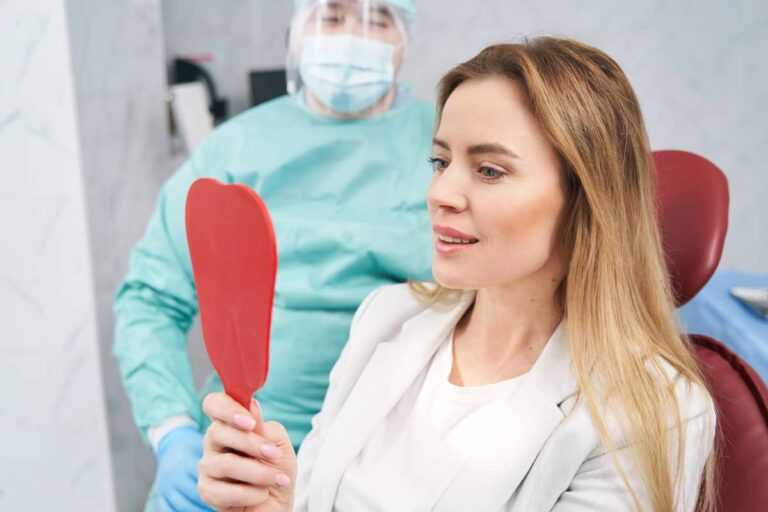

Make an appointment
You can make an appointment by filling out the application form on the website, as well as using instant messengers:
Make an appointment
You can make an appointment by filling out the application form on the website, as well as using instant messengers:


Make an appointment easily using chatbots:
Also, call the numbers:
Modern dentistry and medical centre "MED-DEO"
Choose a clinic whose location is more convenient for you.
Kyiv, Holosiivska/Demiivska metro station
130 Lobanovskoho Avenue


Working hours:
Mon - Sun: 8:00 AM - 9:00 PM
No days off!
Call the numbers:
How to get to us? Create a route
Create a route
Kyiv, Akademistechko metro station
78A, Irpinska str.


Working hours:
Mon-Sun: 8.00-21.00
Without days off!
Call the numbers:
How to get to us?
Create a route
Create a route
Kyiv, Heroiv Dnipra metro station
32A, Heroiv Dnipra str.


Working hours:
Mon-Sun: 8.00-21.00
Without days off!
Call the numbers:
How to get to us?
Create a route
Create a route
Kyiv, Teatralna metro station
9B, E. Chykalenko (Pushkinska) str.


Working hours:
Mon-Sat: 8.00 - 21.00. Sun: by appointment.
Without days off!
Call the numbers:
How to get to us?
Create a route
Create a route
Відгук від клієнта
0:00
0:00


Your email will not be published on the site.