Special offer! Comprehensive professional teeth cleaning for only 1699 UAH.
Special offer! Comprehensive professional teeth cleaning for only 1699 UAH.
Special offer! Comprehensive professional teeth cleaning for only 1699 UAH.
Special offer! Comprehensive professional teeth cleaning for only 1699 UAH.
Special offer! Comprehensive professional teeth cleaning for only 1699 UAH.
Special offer! Comprehensive professional teeth cleaning for only 1699 UAH.
Special offer! Comprehensive professional teeth cleaning for only 1699 UAH.
Special offer! Comprehensive professional teeth cleaning for only 1699 UAH.
Special offer! Comprehensive professional teeth cleaning for only 1699 UAH.
Special offer! Comprehensive professional teeth cleaning for only 1699 UAH.
Sign up
 (044) 394 90 94
(044) 394 90 94  Holosiivska/Demiivska metro station
Sign up
(044) 394 90 94
(044) 394 90 94
Doctors


 Prices
Blog
Contacts
Prices
Blog
Contacts
пр.Лобановського, 130, Київ, Україна
Temporarily closed
Opening soon
78A, Irpinska St., Kyiv, Ukraine
Temporarily closed
Opening soon
32A, Heroiv Dnipra St., Kyiv, Ukraine
Temporarily closed
Opening soon
9B, Yevhena Chykalenko St. (Pushkinska), Kyiv, Ukraine
Temporarily closed
Opening soon
(044) 394 90 94
Back
Dentistry
General Dentistry
Dental surgery
Dental Implants
Maxillofacial Surgery
Dental prosthetics
Cosmetic dentistry

Professional Dental Hygiene

Periodontics
Orthodontic dentistry

Gnathology & TMJ Therapy

Pediatric Dentistry
Dental X-Rays
Back
Orthodontic Center
Orthodontic dentistry
Gnathology & TMJ Therapy
Back
Prosthodontic Center
Dental prosthetics
Back
MED-DEO Center for Maxillofacial Surgery & Facial Plastics
Maxillofacial Surgery
Plastic surgery
Back
Surgical Dental Center
Dental surgery
Dental Implants
Search on the site


Popular requests
Teeth whitening
Treatment of caries
Wisdom tooth extraction
Bracket system
Dental veneers
Tooth restoration
Pediatric dentist
Consultation with a dentist-therapist
Search results by: «».
Unfortunately, no results were found for your search: “Pediatric Endocrinologist”, nothing was found.
You may find these links useful:
Clinics "MED-DEO"
пр.Лобановського, 130, Київ, Україна
Temporarily closed
Opening soon
78A, Irpinska St., Kyiv, Ukraine
Temporarily closed
Opening soon
32A, Heroiv Dnipra St., Kyiv, Ukraine
Temporarily closed
Opening soon
9B, Yevhena Chykalenko St. (Pushkinska), Kyiv, Ukraine
Temporarily closed
Opening soon
Services
Dentistry Orthodontic Center Prosthodontic Center MED-DEO Center for Maxillofacial Surgery & Facial Plastics Surgical Dental CenterGeneral Dentistry
Dental surgery
Dental Implants
Maxillofacial Surgery
Dental prosthetics
Cosmetic dentistry
Professional Dental Hygiene
Periodontics
Orthodontic dentistry
Gnathology & TMJ Therapy
Pediatric Dentistry
Dental X-Rays
Orthodontic dentistry
Gnathology & TMJ Therapy
Dental prosthetics
Maxillofacial Surgery
Dental surgery
Dental Implants

A dental cyst isn’t something to panic about the moment you hear the diagnosis, but it’s not a problem you can simply wait out, either. It often develops slowly, sometimes stays painless for a long time, and is discovered by accident — say, on an X-ray taken before a treatment or before getting a crown fitted.
Most often, a cyst is linked to a chronic infection at the root of a tooth. The body essentially tries to “wall off” the inflammation from healthy tissue by forming a capsule around it. That’s exactly why a tooth cyst can sit there almost unnoticed for a long time, yet gradually grow, destroy bone tissue, and lead to complications.
What a Dental Cyst Is and How It Forms
What exactly is a dental cyst? A dental cyst is an abnormal growth that forms at the root of a tooth or within the jaw tissue, typically as the body’s response to infection. Put simply, it’s a fluid-filled sac with its own lining, and that fluid can include inflammatory matter.
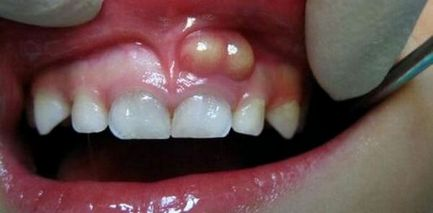
Here’s an important distinction: a dental cyst is not the same thing as a tumor. The word “cyst” sounds alarming, but in dentistry it usually just means the after-effect of a long-running inflammatory process. That said, it’s not a harmless little pouch you can ignore, either. Left untreated, a cyst can grow larger, damage bone and neighboring teeth, and flare up periodically.
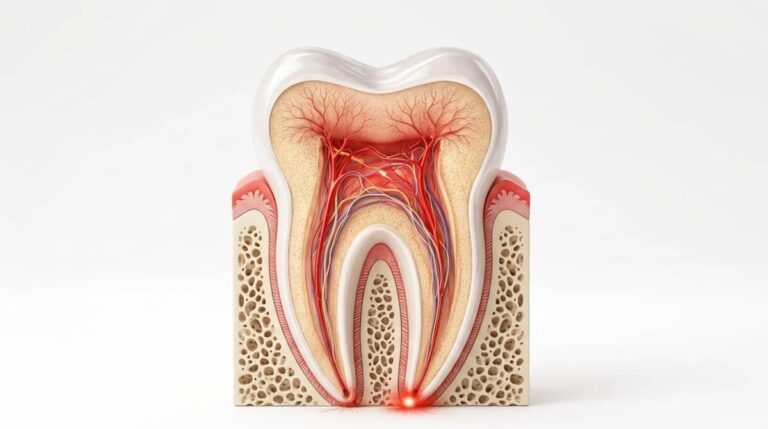
In most cases, the process unfolds gradually. Infection works its way into the root canals or the tissue surrounding the root, the inflammation turns chronic, and the body builds a capsule to contain its spread. That’s how a tooth cyst forms.
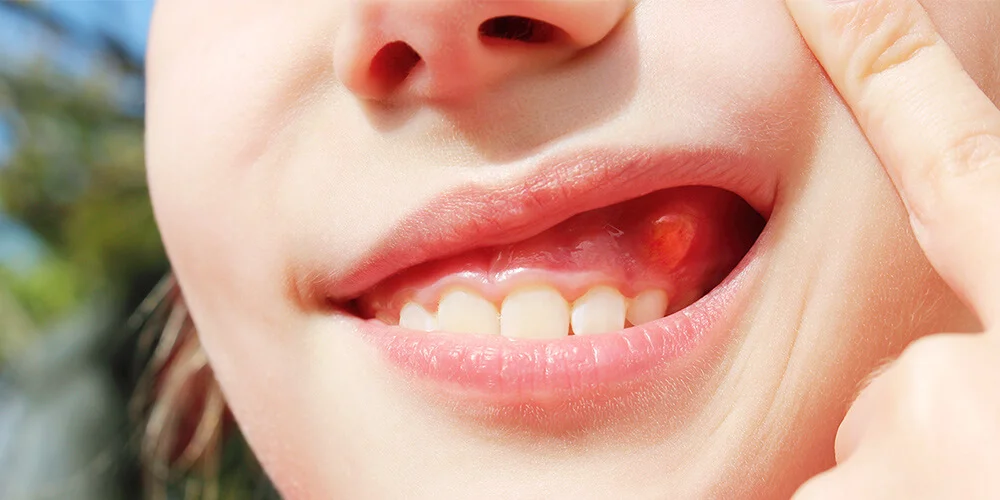
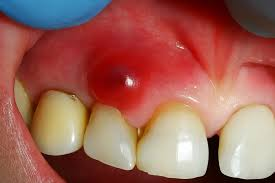
What a dental cyst looks like:
Why Dental Cysts Develop
The main cause of a cyst is infection. Most cases start with untreated cavities, pulpitis, or periodontitis. Once bacteria work their way deep inside a tooth, they can reach the root canals and the tissue around the root tip.
The typical progression looks like this: infection enters the tissue, chronic inflammation sets in, the body tries to contain it, a capsule gradually forms, which becomes a full-blown dental cyst.
A cyst can also develop after a tooth injury, poor-quality root canal treatment, a leak under an old filling or crown, or — sometimes — after a tooth extraction, if a chronic inflammatory focus was left behind in the tissue.
Infectious Causes
The most common scenario is simply letting a cavity go untreated for too long. First it eats through the enamel and dentin, then the infection reaches the pulp — the tooth’s inner tissue containing nerves and blood vessels. That’s pulpitis.
If the inflammation pushes further, it moves past the root and into the surrounding tissue. That’s periodontitis. With chronic periodontitis, pain can be mild or even absent, which is exactly why people tend to put off treatment. But the inflammatory process doesn’t go anywhere in the meantime.
This is precisely why a cyst can form slowly and quietly. The tooth might not hurt every day, but an infection is steadily sustained at the root, keeping the chronic inflammation alive.
Trauma, Treatment Errors, and Post-Extraction Cysts
A cyst can develop for reasons beyond cavities. Sometimes the trigger is a tooth injury — a blow, a fall, heavy mechanical stress. After trauma, the nerve inside a tooth can gradually die off even if the tooth looks intact on the outside. Over time, this can lead to inflammation at the root.
Another possible factor is substandard endodontic treatment. If the root canals weren’t fully cleaned, weren’t sealed all the way through, or still harbored infection, the inflammation can persist for years. The risk also rises if there’s a microleak under an old filling or crown: bacteria gradually work their way in and keep the infectious process going.
A separate case is a cyst that appears after a tooth extraction, known as a residual cyst. It can form if an inflammatory focus or the lining of a previous cyst was left behind in the bone tissue after extraction. This condition also calls for diagnosis and treatment.
Types of Dental Cysts
Dentistry recognizes several types of cysts, and for the patient, what matters isn’t so much the name as understanding the underlying cause and the treatment approach that follows. One type of cyst may be tied to a chronic infection at the tooth root, another to an unerupted tooth, and yet another may persist after an extraction. That’s why a dentist evaluates not just the presence of a cyst, but also its location, size, relationship to the tooth, and the condition of the surrounding bone.
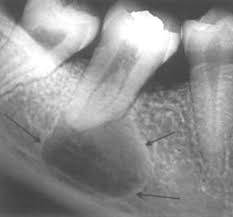
A radicular cyst is the most common type. It forms at the root tip, usually as a result of long-term inflammation. Most cases start with an untreated cavity: the infection gradually works its way inside the tooth, reaches the pulp, then spreads to the root canals and the tissue around the root. Once the process becomes chronic, the body tries to contain the inflammation, and a capsule gradually forms around it. That’s how the cyst appears. Often, such a tooth has already been treated, has hurt before, or has an old filling or crown.
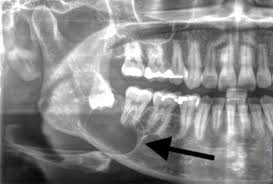
A follicular cyst is associated with a tooth that never erupted or erupted improperly. It forms around the crown of an unerupted tooth or its developing bud. These cysts are most often found around impacted wisdom teeth, though they can be linked to other teeth as well. A distinctive feature of a follicular cyst is that a person may go a long time without noticing any symptoms at all, until the growth gets larger or shows up by chance on a scan. Treatment depends on the cyst’s size, the tooth’s position, and the risk it poses to neighboring structures.
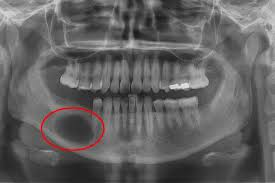
A residual cyst is one that remains or forms after a tooth has been extracted. In other words, the tooth that caused the problem is gone, but a cystic growth tied to the earlier chronic inflammation can still persist in the bone tissue. This happens when a cyst or granuloma was already present at the root before extraction, and inflamed tissue was left behind in the bone afterward. A residual cyst may go unnoticed for a long time, but that doesn’t mean it can be left unmonitored. It requires an exam, X-ray diagnostics, and in some cases, surgical treatment.
A Cyst on the Gum, Under the Tooth, in the Jaw — What These Terms Actually Mean
Patients often describe the problem in plain terms: a “cyst on the gum,” a “cyst under the tooth,” a “cyst in the jaw.” That’s understandable, but medically speaking, these phrases don’t always point to the same condition. Behind them could be anything from chronic inflammation at the root to a fistula, an abscess, or a growth within the bone tissue.
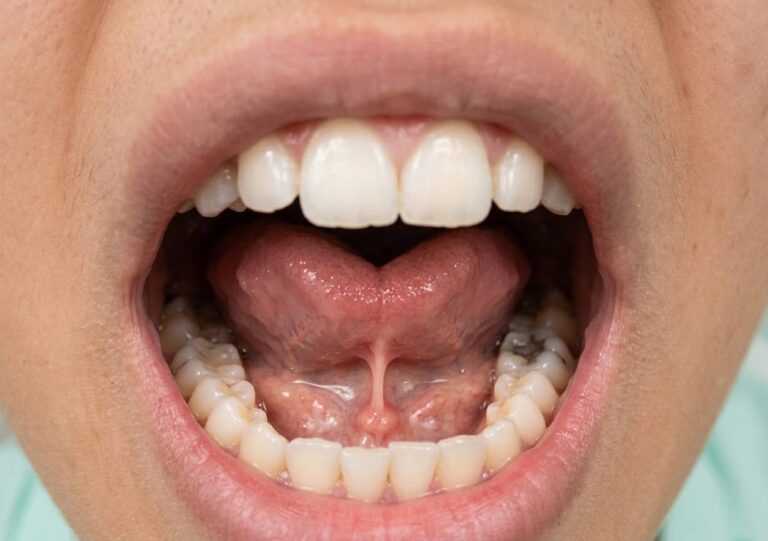
When someone says “cyst on the gum,” they usually mean swelling, a white or reddish spot, a “pimple” on the gum, or an opening that periodically discharges pus. Often this isn’t the cyst itself but a fistula — a channel through which the body drains pus from an inflammatory focus at the tooth root. So while the problem appears to be “on the gum,” its actual source may lie much deeper — in the root canals or the bone around the tooth.
The phrase “cyst under the tooth” usually refers to a growth at the root tip. This is how patients commonly describe a radicular cyst or other chronic inflammation, which shows up on an X-ray as a dark area beneath the root. Such a tooth might hurt when biting down, react to pressure, or show no symptoms at all.
“Cyst in the jaw” is a broader term. It can refer to a growth within the bone tissue of the upper or lower jaw, which isn’t always easy to assess during a routine exam. In these cases, it’s important to determine which tooth the cyst is connected to, whether it affects neighboring teeth, and how close it sits to the sinus cavity, the mandibular canal, or other anatomical structures.
This is exactly why you shouldn’t self-diagnose based on appearance or sensation alone. The same complaint can have different underlying causes, and treatment will vary accordingly. To pin down whether it’s a cyst, a granuloma, a fistula, an abscess, or something else, you need a dental exam, an X-ray, and sometimes a CT scan. This makes it possible to see not just a “shadow” on the image, but the actual size of the growth, its boundaries, and its relationship to the teeth.
Dental Cyst: Symptoms and Early Signs
A dental cyst doesn’t always announce itself right away. That’s exactly what makes it tricky: the inflammatory process at the root can persist for months or even years while the person feels no significant pain. The tooth might look completely normal, show no reaction to hot or cold, and cause no daily discomfort — yet a gum cyst could already be forming or growing within the bone tissue.
Early signs tend to be vague. It’s not always sharp pain that keeps you up at night. Sometimes a person notices only mild discomfort when biting down, a sense of pressure around the tooth, or an occasional “reminder” from the tooth after getting chilled, stressed, or catching a cold.
The most common symptoms of a dental cyst include:
- Discomfort or pain when biting down
- A feeling of pressure or fullness at the tooth root
- Intermittent aching pain
- Swelling or redness of the gums
- Tenderness when pressing on the gums
- A “pimple” appearing on the gums
- A fistula that may discharge pus
- An unpleasant taste or odor in the mouth
- Cheek swelling during a flare-up
- Fever
- General weakness or malaise
Symptoms sometimes come in waves: the tooth acts up for a few days, then everything seems to settle down. This can create the impression that the problem “resolved on its own.” In reality, the acute phase likely just quieted down, while the underlying chronic inflammation remained.
When a Cyst Doesn’t Hurt
A dental cyst really can be painless. This is a fairly common situation, especially when the inflammation follows a chronic course. The body works to contain the infection, a capsule gradually forms around the affected area, and the process can stay almost unnoticeable for a long time.
That’s why a person might have no obvious complaints, yet the dentist sees a dark patch at the root on an X-ray. Such findings are often discovered by chance — during prep work for a crown, an implant, a tooth extraction, root canal treatment, or a routine checkup.
A dental cyst may not hurt if:
- The inflammation is progressing slowly
- The pus has an outlet through a fistula
- The infectious process isn’t currently flaring up
- The tooth is already “dead” after nerve death or prior root canal treatment
- The body is temporarily holding the infection in check
But the absence of pain doesn’t mean the cyst is harmless. It can keep growing, destroy bone tissue, affect neighboring teeth, and flare up at any moment. Patients often say something like, “The tooth never hurt, then suddenly my cheek swelled up.” In reality, the process most likely had been going on for a while — it simply hadn’t produced noticeable symptoms until that point.
Pain, Swelling, Fever, Pus
Pain, swelling, fever, or pus are all signs of active inflammation. At this stage, a cyst or another infectious focus at the root stops being a “silent” problem and enters a flare-up phase. This can happen after getting chilled, a drop in immunity, a cold, stress, a tooth injury, or a flare-up of a chronic infection.
The following symptoms should raise particular concern:
- Pain that worsens when biting down or pressing on the tooth
- Gums near the tooth that are swollen, red, or tender
- A “pimple” appearing on the gums
- Pus discharging from the gum
- An unpleasant taste in the mouth
- A swollen cheek
- A tooth that feels “raised” and interferes with closing the jaw
- Fever
- Weakness, body aches, general malaise
- Pain radiating to the jaw, temple, ear, or cheek
These symptoms shouldn’t be waited out. If there’s pus, swelling, or fever, it means the infection is active and could spread to surrounding tissue. In that case, see a dentist as soon as possible.
Before your appointment, don’t apply heat to the cheek, use hot compresses, pierce the gums, squeeze out pus, or try to “open” the cyst yourself. These actions can make things worse and speed up the spread of infection. Don’t start taking antibiotics on your own, either: they might temporarily mask the symptoms, but they won’t address the underlying cause — the infected canals, the cyst, or whatever other source of inflammation is at play.
Seek help urgently if the swelling is growing quickly, the pain becomes intense, opening your mouth is difficult, your temperature rises, or your overall condition worsens. In these situations, delaying treatment can be dangerous.
Cyst, Granuloma, or Abscess: How to Tell Them Apart
It’s nearly impossible for a patient to reliably distinguish a cyst from a granuloma, an abscess, a gumboil, or another purulent process on their own. The symptoms can look alike: pain, swelling, discomfort when biting down, a fistula, pus.
A granuloma is also a chronic inflammatory growth at the root, but its structure differs from that of a cyst. An abscess is an acute collection of pus in the tissue. In everyday language, many of these conditions get lumped together as a “gumboil,” though that’s not always medically precise.
So relying on internet photos or your own sensations isn’t reliable. A definitive answer comes only after an exam, an X-ray, or a CT scan.
What a Dental Cyst Looks Like on a Scan and How It’s Diagnosed
On an X-ray, a cyst often shows up as a dark, round or oval area near the root tip. That dark zone indicates that the bone tissue in that spot has been altered or partially destroyed by the inflammatory process.
But a standard X-ray alone isn’t always enough. It shows the situation in two dimensions, so it doesn’t always give the full picture — the growth’s size, its exact position, or its relationship to neighboring teeth, the sinus cavity, or other important anatomical structures.
In more complex cases, the dentist may order a CT scan. A CT scan provides a three-dimensional view, allowing the dentist to assess the cyst’s size, the condition of the roots, the quality of canal filling, the extent of bone destruction, and whether the tooth can be saved.
Diagnosis isn’t based on the scan alone. The dentist also examines the tooth, checks the gums, and assesses the response to biting pressure, prior treatment, and the presence of fillings, crowns, a fistula, or swelling.
Why Dental Cysts Are Dangerous and What the Consequences Can Be
A dental cyst is dangerous not because it’s inherently frightening, but because, left untreated, it can gradually grow and destroy the surrounding tissue. The longer the inflammatory process continues, the harder it sometimes becomes to save the tooth.
Possible consequences include bone tissue destruction, damage to neighboring teeth, recurring flare-ups, pus formation, swelling, pain, and tooth loss. If the cyst is located in the upper jaw, the process can sometimes involve the sinus cavity.
Local Complications
Why is a dental cyst dangerous for a person? Most often, the cyst affects the tissue surrounding the tooth. It can grow larger, gradually destroy bone, weaken the tooth’s support, and complicate further treatment.
If the inflammation spreads, it’s not just the affected tooth that can suffer — neighboring teeth can be affected too. In severe cases, the tooth ends up being extracted, even though it might have been saved at an earlier stage.
Another risk is recurring flare-ups. A dental cyst can stay quiet for a long time, then suddenly trigger pain, swelling, and a purulent process.
Related Symptoms and the Spread of the Process
Sometimes a dental cyst or root inflammation causes pain that radiates to the jaw, cheek, temple, or ear. The person may feel as though the pain isn’t coming from one specific tooth but from an entire region of the face.
If the process is located near the upper teeth, especially in the premolar and molar area, it can sit close to the sinus cavity. In some cases, this is associated with symptoms resembling sinusitis: pressure around the sinus, discomfort, and one-sided congestion.
During a flare-up, general malaise, weakness, and fever are also possible. That’s already a sign the body is actively responding to the infection.
How Dental Cysts Are Treated: With and Without Surgery
Treatment for a cyst depends on its size, its underlying cause, the tooth’s condition, the quality of any prior canal treatment, and whether the source of infection can be eliminated.
Sometimes the tooth can be saved without surgery — through proper endodontic treatment or by retreating the canals. In other cases, surgery is needed: removing the cyst, performing a root tip resection, or extracting the tooth if it’s too badly damaged to have a viable prognosis.
The key point is this: don’t try to treat a cyst with home remedies. Rinses, compresses, and pills won’t remove the cyst’s capsule or clear the infection out of the root canals.
When the Tooth Can Be Saved
A tooth can often be saved if its crown portion isn’t critically damaged, the root canals are accessible for proper treatment, and the inflammatory process can be controlled.
In such cases, endodontic treatment is performed: the canals are cleaned out, treated, cleared of infection, and sealed tightly. If the tooth has been treated before, the canals may need to be retreated.
After that, the dentist monitors the situation over time. Bone tissue doesn’t regenerate instantly, so a follow-up X-ray is usually taken after a certain period. What matters isn’t just “closing up” the tooth, but actually eliminating the source of infection.
When Surgery or Extraction Is Needed
Surgery may be necessary if the cyst is large, the root anatomy is complex, the inflammation doesn’t clear up after canal treatment, or the tooth can no longer be properly retreated.
Sometimes a root tip resection is performed — removing part of the root along with the inflamed growth. This makes it possible to save the tooth in cases where standard canal treatment isn’t enough.
Extraction is considered when the tooth is severely damaged, has a cracked root, can’t be restored, or keeps sustaining the infection. In such situations, trying to save the tooth may be less safe and less predictable than extracting it and following up with a restoration plan.
What to Do About Pain, Swelling, or Pus — and What Not to Do at Home
If pain, swelling, pus, a fistula, or fever shows up, see a dentist as soon as possible. These symptoms can signal that the infection has flared up.
Before your appointment, don’t apply heat to the cheek, use hot compresses, pierce the gums, squeeze out pus, or try to “open” the cyst yourself. Heat can intensify the inflammation, and physical interference can push the infection deeper into the tissue.
Don’t start taking antibiotics on your own without a prescription, either. They may temporarily ease symptoms, but they won’t address the underlying cause — infected canals, a cyst, or another source of inflammation.
Seek help urgently if the swelling grows quickly, opening your mouth becomes difficult, your temperature rises, you start feeling weak, the pain intensifies, or the swelling spreads to your face. In these cases, delaying treatment is risky.
A couple of frequently asked questions deserve a direct answer: what can be done to make a dental cyst go away on its own, and how can you drain pus from a cyst at home? In reality, you can’t make a cyst “dissolve” at home. Rinses, compresses, or painkillers might ease the discomfort temporarily, but they won’t address the underlying cause — the infection at the tooth’s root. You also shouldn’t try to drain pus from a cyst yourself at home.
For a cyst to start shrinking, the source of inflammation needs to be eliminated, and that means seeing a dentist.
Recovery After Treatment and Preventing Recurrence
After cyst treatment, some discomfort can linger for a few days. This depends on the extent of the procedure — whether only the canals were treated, whether the cyst was surgically removed, and whether there was an active purulent process.
It’s normal to experience moderate sensitivity when biting down, mild swelling after surgery, and discomfort in the treated area. But the pain shouldn’t keep increasing, and the swelling shouldn’t keep growing quickly. If symptoms intensify, or if fever or pus appears, you should see your dentist again.
To check on the results, the dentist may order a follow-up X-ray. This matters because bone tissue heals gradually, and progress can only be assessed over time.
To lower the risk of recurrence, it’s important to treat cavities promptly, not put off treating pulpitis or periodontitis, properly restore teeth after canal treatment, check old fillings and crowns, and keep up with regular dental checkups. If a tooth has already had endodontic treatment but keeps bothering you from time to time, it’s better not to wait for a flare-up.
Questions and Answers (FAQ)
Can a dental cyst be painless?
Yes, it can. A cyst often develops slowly and goes a long time without producing noticeable symptoms.
Can a dental cyst go away on its own?
Usually not. A cyst is tied to chronic inflammation and has its own capsule, so it doesn’t resolve by itself.
What does a dental cyst look like on an X-ray?
On a scan, a cyst often appears as a dark, round area at the tooth’s root.
Is a cyst dangerous after a tooth extraction?
This kind of cyst shouldn’t be ignored. If an inflammatory growth remains in the bone after a tooth extraction, it can grow larger or flare up periodically.
The author of this article is Ivan Plysko, a prosthodontist, general dentist, and oral surgeon.



Make an appointment
You can make an appointment by filling out the application form on the website, as well as using instant messengers:
Make an appointment
You can make an appointment by filling out the application form on the website, as well as using instant messengers:


Make an appointment easily using chatbots:
Also, call the numbers:
Modern dentistry and medical centre "MED-DEO"
Choose a clinic whose location is more convenient for you.
Kyiv, Holosiivska/Demiivska metro station
130 Lobanovskoho Avenue


Working hours:
Mon - Sun: 8:00 AM - 9:00 PM
No days off!
Call the numbers:
How to get to us? Create a route
Create a route
Kyiv, Akademistechko metro station
78A, Irpinska str.


Working hours:
Mon-Sun: 8.00-21.00
Without days off!
Call the numbers:
How to get to us?
Create a route
Create a route
Kyiv, Heroiv Dnipra metro station
32A, Heroiv Dnipra str.

Working hours:
Mon-Sun: 8.00-21.00
Without days off!
Call the numbers:
How to get to us?
Create a route
Create a route
Kyiv, Teatralna metro station
9B, E. Chykalenko (Pushkinska) str.



Working hours:
Mon-Sat: 8.00 - 21.00. Sun: by appointment.
Without days off!
Call the numbers:
How to get to us?
Create a route
Create a route
Відгук від клієнта
0:00
0:00


Your email will not be published on the site.