Special offer! Comprehensive professional teeth cleaning for only 1699 UAH.
Special offer! Comprehensive professional teeth cleaning for only 1699 UAH.
Special offer! Comprehensive professional teeth cleaning for only 1699 UAH.
Special offer! Comprehensive professional teeth cleaning for only 1699 UAH.
Special offer! Comprehensive professional teeth cleaning for only 1699 UAH.
Special offer! Comprehensive professional teeth cleaning for only 1699 UAH.
Special offer! Comprehensive professional teeth cleaning for only 1699 UAH.
Special offer! Comprehensive professional teeth cleaning for only 1699 UAH.
Special offer! Comprehensive professional teeth cleaning for only 1699 UAH.
Special offer! Comprehensive professional teeth cleaning for only 1699 UAH.
Sign up
 (044) 394 90 94
(044) 394 90 94  Holosiivska/Demiivska metro station
Doctors


 Prices
Blog
Contacts
Prices
Blog
Contacts
пр.Лобановського, 130, Київ, Україна
Temporarily closed
Opening soon
78A, Irpinska St., Kyiv, Ukraine
Temporarily closed
Opening soon
32A, Heroiv Dnipra St., Kyiv, Ukraine
Temporarily closed
Opening soon
9B, Yevhena Chykalenko St. (Pushkinska), Kyiv, Ukraine
Temporarily closed
Opening soon
Sign up
En
(044) 394 90 94
Back
Dentistry
General Dentistry
Dental surgery
Dental Implants
Maxillofacial Surgery
Dental prosthetics
Cosmetic dentistry

Professional Dental Hygiene

Periodontics
Orthodontic dentistry

Gnathology & TMJ Therapy

Pediatric Dentistry

Dental X-Rays
Back
Orthodontic Center
Orthodontic dentistry
Gnathology & TMJ Therapy
Back
Prosthodontic Center
Dental prosthetics
Back
MED-DEO Center for Maxillofacial Surgery & Facial Plastics
Maxillofacial Surgery
Plastic surgery
Back
Surgical Dental Center
Dental surgery
Dental Implants
Search on the site


Popular requests
Teeth whitening
Treatment of caries
Wisdom tooth extraction
Bracket system
Dental veneers
Tooth restoration
Pediatric dentist
Consultation with a dentist-therapist
Search results by: «».
Unfortunately, no results were found for your search: “Pediatric Endocrinologist”, nothing was found.
You may find these links useful:
Clinics "MED-DEO"
пр.Лобановського, 130, Київ, Україна
Temporarily closed
Opening soon
78A, Irpinska St., Kyiv, Ukraine
Temporarily closed
Opening soon
32A, Heroiv Dnipra St., Kyiv, Ukraine
Temporarily closed
Opening soon
9B, Yevhena Chykalenko St. (Pushkinska), Kyiv, Ukraine
Temporarily closed
Opening soon
Services
Dentistry Orthodontic Center Prosthodontic Center MED-DEO Center for Maxillofacial Surgery & Facial Plastics Surgical Dental CenterGeneral Dentistry
Dental surgery
Dental Implants
Maxillofacial Surgery
Dental prosthetics
Cosmetic dentistry
Professional Dental Hygiene
Periodontics
Orthodontic dentistry
Gnathology & TMJ Therapy
Pediatric Dentistry
Dental X-Rays
Orthodontic dentistry
Gnathology & TMJ Therapy
Dental prosthetics
Maxillofacial Surgery
Dental surgery
Dental Implants
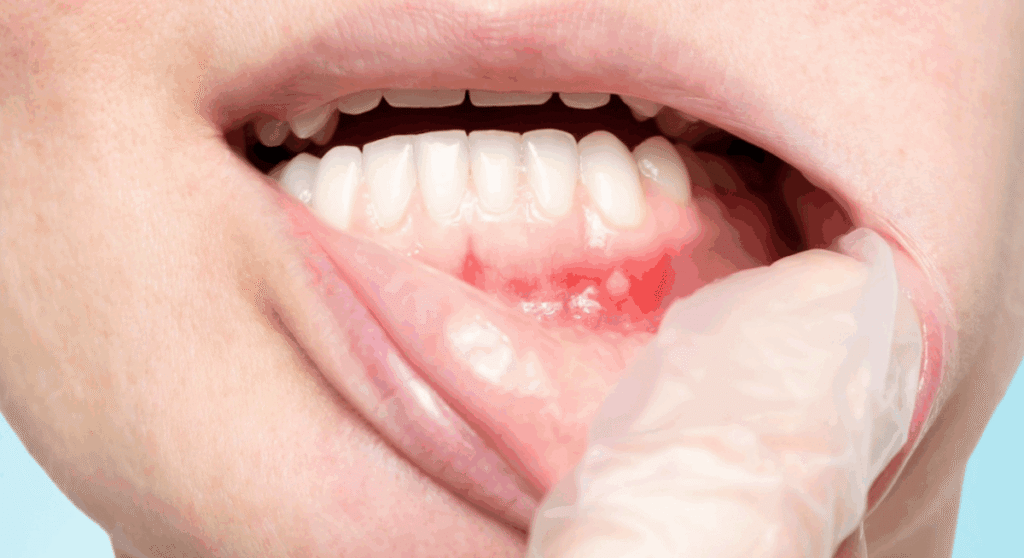
White plaque on gums is something everyone encounters — from children to adults. Sometimes it’s a temporary, harmless phenomenon, and sometimes it’s a sign of inflammation or infection that requires a dentist’s attention. Understanding why it appears helps determine whether you can handle it on your own or need to see a specialist.
What Is White Plaque on Gums: Types and Characteristics
White plaque on gums is a mixture of bacteria, dead cells, food debris, and saliva. It can appear due to poor oral hygiene, fungal infections (such as candidiasis), or even problems with internal organs. The plaque varies in form: from a thin film to cottage cheese-like spots or dense white patches (leukoplakia). Some types of plaque should be shown to a dentist, as they may indicate stomatitis, periodontitis, or even precancerous changes.
- Plaque is usually soft and easily removed with a toothbrush, but may reappear.
- Spots or dots are rarely removed by brushing and may indicate inflammation.
- Denser formations sometimes cause pain and sometimes don’t, but should still be examined by a doctor.
Pay attention to the texture and whether the plaque comes off on its own — this helps determine whether it’s a harmless occurrence or a reason to visit a dentist.
Main Causes of White Plaque on Gums
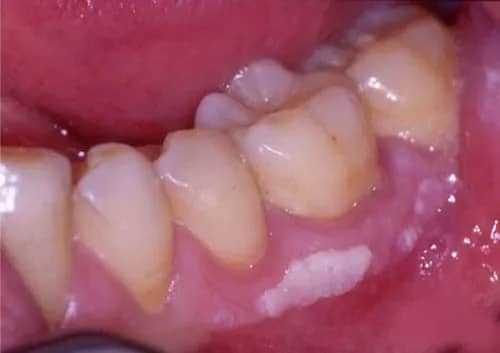
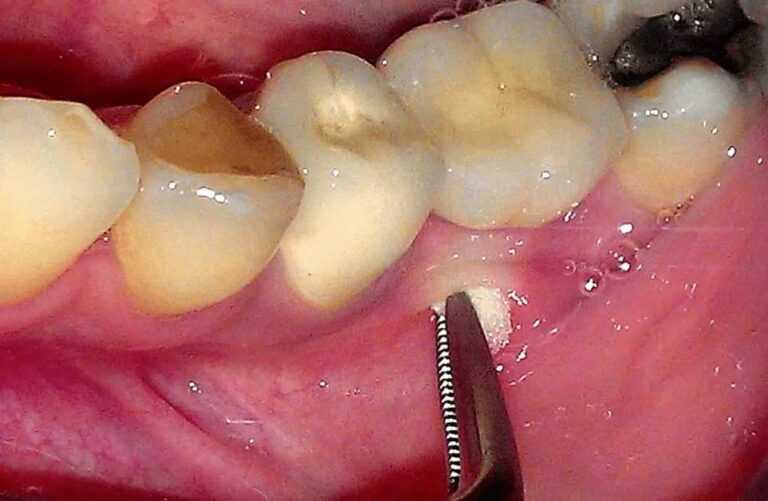
White plaque on gums can appear for various reasons. Sometimes it’s simply food residue or poor hygiene; sometimes it manifests as fibrinous plaque that appears in the socket after a tooth extraction on days 2–4, which is normal. And sometimes it’s a signal of a serious health problem. It is broadly divided into several groups:
- Infectious causes — fungal or viral lesions, bacterial inflammation.
- Injuries — mechanical damage to the mucosa or burns from medications and chemicals.
- Systemic problems — diseases affecting the entire body that manifest on the gums.
- Age-related and physiological features — mucosal changes in children, pregnant women, or older adults.
Aphthous Stomatitis: When a White Spot Hurts
An aphtha is a small ulcer in the mouth or on the gums. At first it looks like a red circle or dot, then the center becomes covered with a white or yellowish film — forming a so-called “crust.” It sometimes looks like a white pimple on the gum.
How it develops:
- An inflamed red spot appears on the gum.
- After a few days, the center becomes covered with white plaque.
- The surrounding gum may swell slightly and turn red.
What contributes to the appearance of aphthae:
- Stress or overexertion.
- Mechanical injuries: biting, sharp tooth edges, hard food.
- Weakened immune system.
- Vitamin deficiencies, especially B vitamins, iron, or folic acid.
- Stomach or intestinal problems.
Symptoms that help identify aphthous stomatitis:
- Pain when eating, drinking, or talking.
- Mild burning or tingling before visible plaque appears.
- Redness and slight swelling around the spot.
Aphthae are usually small (up to 5–10 mm) and resolve on their own within 7–10 days. Recurring outbreaks may indicate a chronic form.
Important: A white spot on the gum may look like an aphtha but actually be a fungal infection, viral condition, or even a more serious disease. It’s important to identify the problem correctly — when in doubt, consult a dentist.
Candidiasis (Oral Thrush)
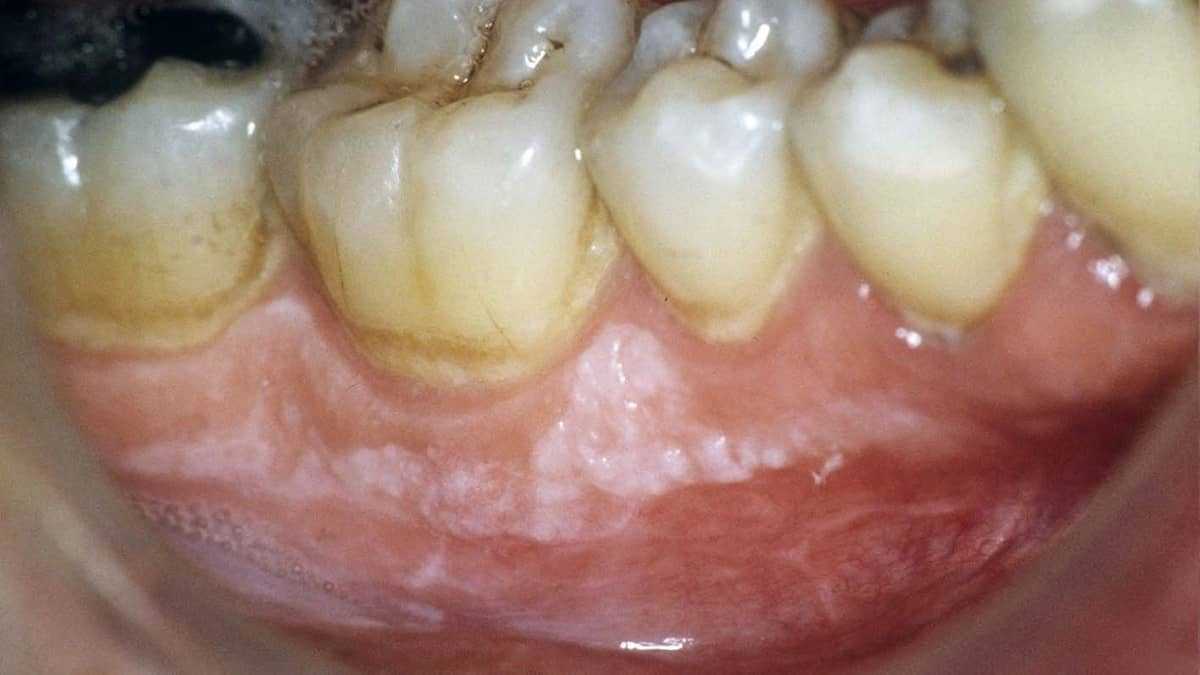
Candidiasis, or oral thrush, is a fungal infection caused by the Candida fungus. It can appear in anyone, but is more common where immunity is weaker or the oral microflora is disrupted. It can sometimes look like a cyst on the gum.
Who is at risk:
- Infants and young children under 3 years old.
- People after prolonged antibiotic use, when “good” oral bacteria are depleted.
- Patients with weakened immunity or chronic diseases such as diabetes.
- Those who wear dental prostheses.
How it looks:
- White deposits appear on the gums, tongue, or inner cheeks.
- They can be easily wiped off, revealing red, tender mucosa underneath — often resembling curdled milk.
- Burning or discomfort may occur, especially while eating.
Forms of candidiasis:
- Acute: appears quickly, noticeable and may be painful.
- Chronic: lasts a long time, recurs over time, sometimes becoming a recurring form.
Important: Oral thrush should not be ignored — in children and people with weakened immunity, it can lead to complications. Treatment must be prescribed by a doctor to eliminate the fungus and prevent recurrence.
Leukoplakia: A Serious White Spot
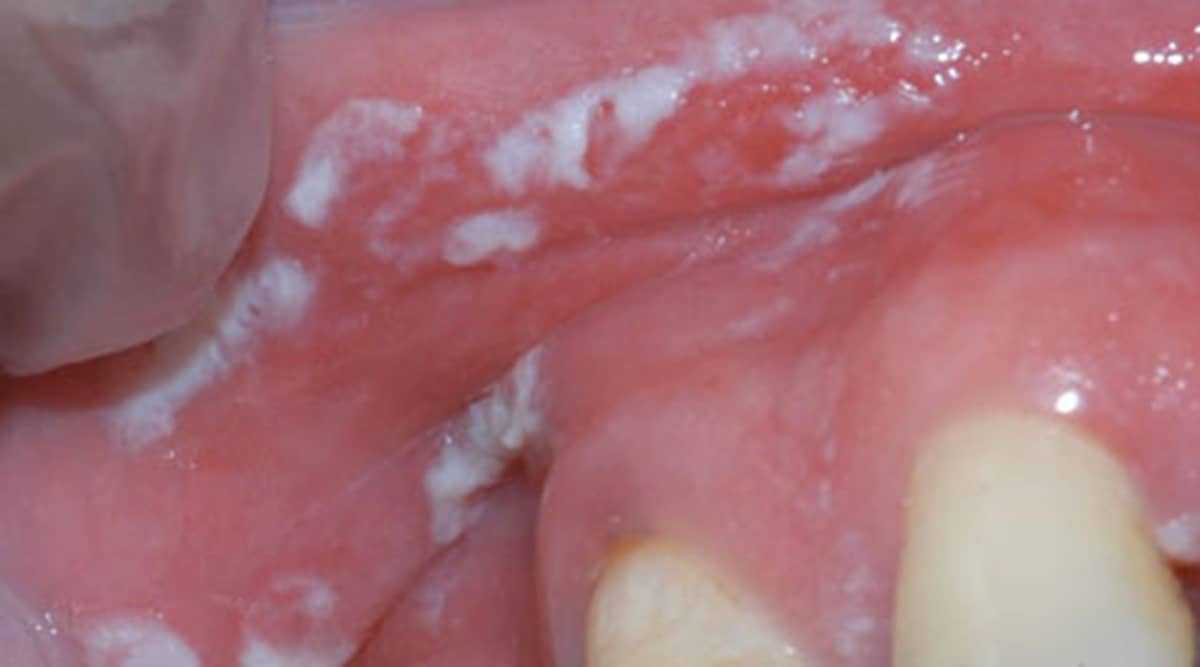
Leukoplakia is a condition in which the mucosa of the gums or mouth thickens and a dense white spot forms. Unlike ordinary plaque or an aphtha, this white spot cannot be removed and initially causes little to no pain.
Why it is serious: Leukoplakia on the gums usually develops due to constant irritation — from smoking, prostheses, or sharp tooth edges — and is considered a condition that may precede cancer. A dentist consultation and full examination are therefore essential.
How it looks:
- A white or grayish spot on the gums, cheeks, or tongue.
- Hard and rough to the touch.
- Does not go away on its own and cannot be removed by brushing.
Who is at risk:
- Men over 40.
- Smokers and people in constant contact with nicotine or other irritants.
- Those whose gums are frequently traumatized — from uneven teeth, prostheses, or sharp food.
What to do:
- Visit a dentist regularly for check-ups.
- If leukoplakia is suspected, the doctor may perform a biopsy to assess the risk of malignant transformation.
- Do not try to “scrape off” the spot yourself — it is not ordinary plaque and will not go away without professional intervention.
Herpetic Stomatitis
Herpetic stomatitis is a viral infection of the oral cavity caused by the herpes simplex virus. It often affects the gums, tongue, or inner cheeks. Small blisters appear on the mucosa first, which then burst and turn into small ulcers. White plaque may form on these ulcers.
Symptoms to recognize it by:
- Pain in the mouth and gums, especially while eating or talking.
- High fever, general weakness, headache.
- Blisters may also appear on the lips or around the nose.
Key features:
- Often recurs when immunity is weakened.
- Distinguished from other white spots by the combination of blisters, pain, and general malaise.
What to do:
- Do not ignore symptoms — see a dentist or general practitioner.
- Treatment includes antiviral medications, oral antiseptics, and immune support.
- Do not touch the blisters to avoid spreading the infection further.
Injuries and Chemical Burns
White spots on the gums can appear not only due to infections but also from mechanical injuries or chemical burns.
Mechanical injuries:
- Occur when you accidentally bite your gum, or from sharp tooth edges, hard food, or a toothbrush that is too stiff.
- A white “film” or crust may form at the site of injury — this is dead tissue protecting the affected area while it heals.
- Such spots usually don’t hurt much but may cause mild discomfort while eating or talking.
Chemical burns:
- Can occur from improper use of medications, such as aspirin or strong hydrogen peroxide solution.
- Other aggressive substances that come into contact with the mucosa can also cause burns.
- A white spot appears at the burn site, and the mucosa may be red, painful, or swollen.
What to do:
- Minor mechanical injuries often heal on their own with proper oral hygiene and avoiding further trauma.
- If the spot persists, grows, or hurts — see a dentist.
- Chemical burns always require a doctor’s examination to avoid complications and speed up healing.
Special Patient Groups
White plaque on gums manifests differently depending on a person’s age, health status, and physiology.
Infants and Children
In children, white gums are often associated with thrush, but can sometimes be confused with milk residue after feeding.
How to tell the difference:
- Thrush appears as a dense white coating that cannot be wiped off, with red or inflamed mucosa underneath.
- The child may complain of burning or discomfort during feeding.
What to do:
- Monitor the plaque: if it disappears on its own, there’s no need to worry.
- If the spot persists, the mucosa is red, or the child is in pain — consult a pediatrician or pediatric dentist.
- Maintain careful oral hygiene: wipe the gums and tongue with clean gauze or a special baby brush after each feeding.
Pregnant Women
During pregnancy, the gums become more sensitive due to hormonal changes and reduced immunity. The body may also experience calcium and vitamin deficiencies, which contributes to inflammation — gingivitis.
Most common causes of white plaque in pregnant women:
- Oral candidiasis (thrush).
- Aphthous stomatitis (painful white ulcers).
- Traumatic injuries due to increased gum sensitivity.
Treatment considerations:
- Medications are selected based on the trimester and only on a doctor’s recommendation.
- Topical treatments are safer; systemic drugs are used only when prescribed.
- It’s important to maintain oral hygiene and regularly examine the gums.
Tip: Oral health treatment before pregnancy helps prevent gum problems throughout all trimesters.
People with Weakened Immunity and Chronic Diseases
In people with HIV/AIDS, cancer (especially during chemotherapy), diabetes, or autoimmune diseases, white plaque appears more often and is harder to treat.
Why this happens:
- Weakened immunity → common fungi and bacteria become active → infection develops.
- Such infections last longer and require more thorough treatment.
What to do:
- Visit a dentist regularly.
- Follow the doctor’s recommendations for treatment and oral hygiene.
- Do not self-medicate, as the infection can worsen rapidly.
Diagnosing White Spots on Gums
To determine why white spots have appeared on the gums, a dentist performs a thorough examination and several tests.
What the doctor does:
- Takes a medical history: when the spots appeared, what may have triggered them, what symptoms are present.
- Examines the mouth: determines the shape, size, and location of the spots.
- Palpation: checks how dense the tissue is and whether it is painful.
Additional diagnostic methods:
- Mucosal swab — helps determine whether the plaque is caused by bacteria or fungi, and which medication will be effective.
- Biopsy — taken if serious changes are suspected, such as leukoplakia or other formations.
- Blood test — reveals inflammation, anemia, checks blood sugar levels, and assesses immunity if needed.
Proper diagnosis allows for precise treatment of the actual problem. Do not self-diagnose based on photos found online — you may miss a serious condition or start the wrong treatment.
Treatment Methods for White Plaque on Gum
To get rid of white plaque on gums, it’s important to first understand why it appeared. Treatment always depends on the cause, and only a doctor can determine the right approach.
How it is treated:
Eliminating the cause (etiotropic therapy)
- If the plaque is caused by a fungus — antifungal agents are prescribed.
- If caused by bacteria — antibacterial medications.
- For injuries or burns — the irritating factor is removed and the mucosa is helped to heal faster.
Relieving symptoms (symptomatic therapy)
- Helps reduce pain, burning, or inflammation.
- Safe gels, rinses, and topical analgesics are used.
Topical and systemic treatment
- Topical — gels, solutions, or ointments applied directly to the affected areas.
- Systemic — tablets or syrups that act on the whole body for complex or chronic infections.
Comprehensive approach
- Topical and systemic treatments are often combined.
- Oral care plays an important role: regular brushing with a soft toothbrush, rinsing with antiseptic, and proper nutrition.
Treatment is always individualized.
Prevention of White Plaque on Gums
To avoid white plaque and keep the gums healthy, it’s important to take care not just of the mouth, but the whole body.
1. Oral hygiene
- Brush your teeth twice a day for 2 minutes.
- Use dental floss or a water flosser to clean hard-to-reach areas.
- Rinse with an antiseptic mouthwash.
- Replace your toothbrush every 3 months.
2. Nutrition
- Eat a balanced diet: sufficient protein, vitamins (especially B, C, and A) and minerals.
- Limit sugar and carbonated drinks.
- Drink enough water.
3. Healthy lifestyle
- Quit smoking and limit alcohol consumption.
- Get enough sleep and exercise moderately.
- Avoid stress and support your immune system.
- Take vitamin complexes during periods of seasonal deficiency.
4. Dental visits
- Get regular preventive check-ups twice a year.
- Have professional teeth cleaning done.
- Treat cavities, old fillings, and prostheses in a timely manner.
5. Avoiding injuries
- Be careful with hard foods.
- Use a soft or medium-bristle toothbrush.
- Treat chronic diseases promptly, as they can affect gum health.
By following these simple guidelines, you will reduce the risk of white plaque and keep your gums healthy for years to come.
The author of this article is Irina Viktorivna Sashchuk, a general dentist, oral surgeon, and periodontist.


Make an appointment
You can make an appointment by filling out the application form on the website, as well as using instant messengers:
Make an appointment
You can make an appointment by filling out the application form on the website, as well as using instant messengers:


Make an appointment easily using chatbots:
Also, call the numbers:
Modern dentistry and medical centre "MED-DEO"
Choose a clinic whose location is more convenient for you.
Kyiv, Holosiivska/Demiivska metro station
130 Lobanovskoho Avenue


Working hours:
Mon - Sun: 8:00 AM - 9:00 PM
No days off!
Call the numbers:
How to get to us? Create a route
Create a route
Kyiv, Akademistechko metro station
78A, Irpinska str.


Working hours:
Mon-Sun: 8.00-21.00
Without days off!
Call the numbers:
How to get to us?
Create a route
Create a route
Kyiv, Heroiv Dnipra metro station
32A, Heroiv Dnipra str.


Working hours:
Mon-Sun: 8.00-21.00
Without days off!
Call the numbers:
How to get to us?
Create a route
Create a route
Kyiv, Teatralna metro station
9B, E. Chykalenko (Pushkinska) str.


Working hours:
Mon-Sat: 8.00 - 21.00. Sun: by appointment.
Without days off!
Call the numbers:
How to get to us?
Create a route
Create a route
Відгук від клієнта
0:00
0:00


Your email will not be published on the site.