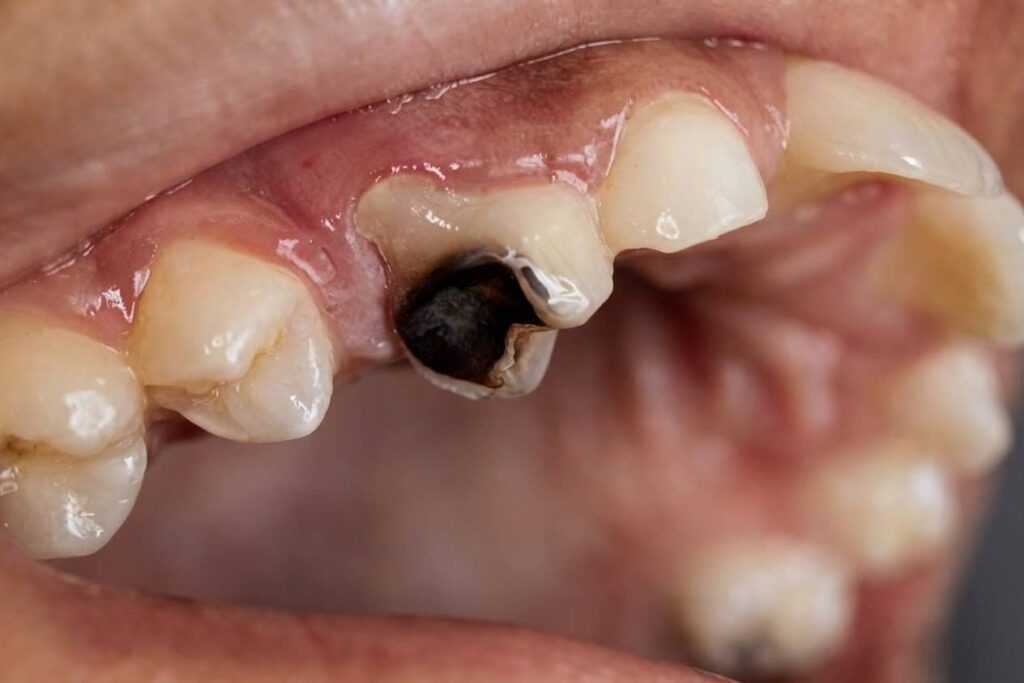
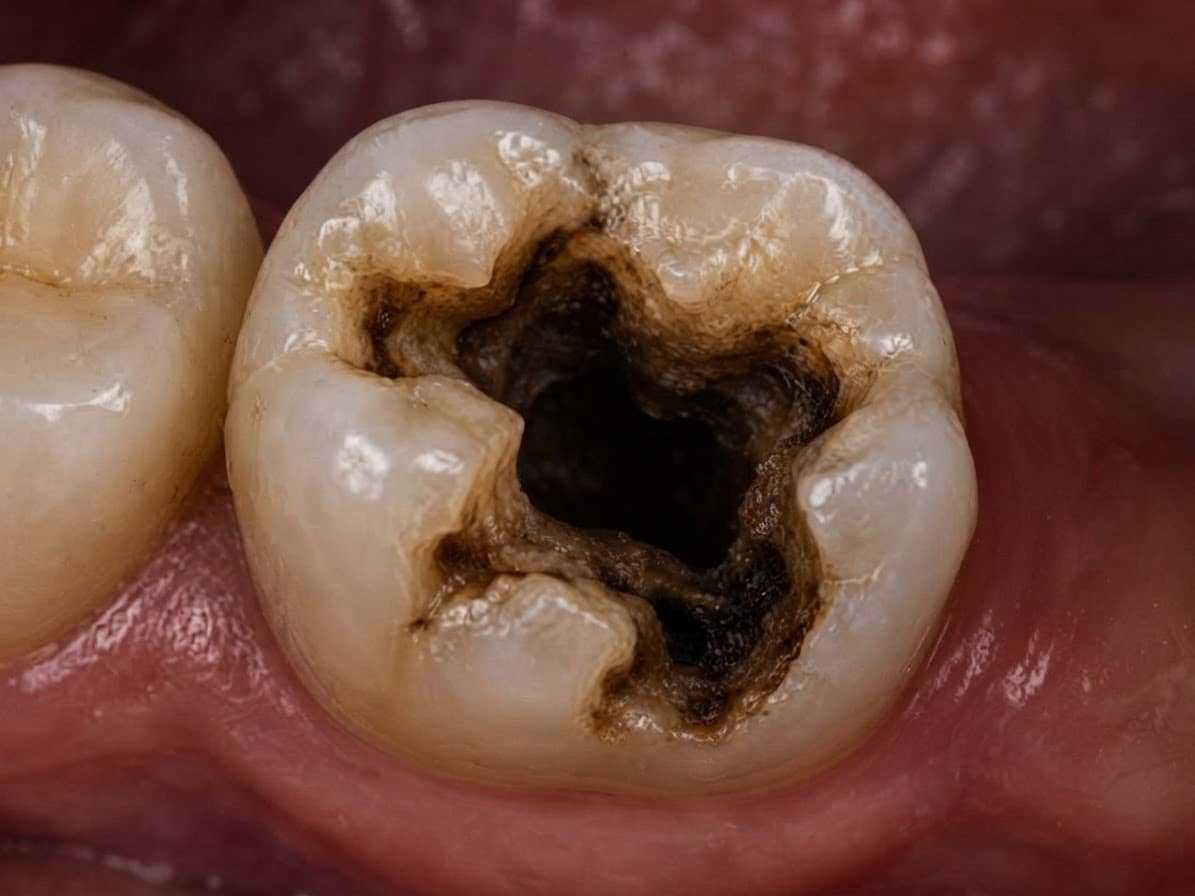
Deep cavity (advanced dental caries) is a late-stage form of tooth decay in which the pathological process has penetrated through the enamel and spread into the deep layers of dentine, leaving only a thin barrier of tissue between the decay and the pulp. Under the ICDAS classification, such lesions are typically categorised as severity levels 5-6.
At this stage, a large cavity has formed within the tooth, and the affected dentine becomes softened, darkened, and loses its natural structural integrity. Without treatment, bacteria and their toxins can reach the pulp, triggering inflammation. From there, the infection can spread to the tissues surrounding the tooth root. The longer treatment is delayed, the greater the risk of more complex intervention – or tooth loss altogether.
What Is Advanced Dental Caries and How Does It Develop?
Advanced dental caries is a late stage of tooth decay in which the destruction extends well beyond the enamel into a significant portion of the dentine. The cavity sits in close proximity to the pulp – the innermost part of the tooth, containing nerve fibres and blood vessels – with sometimes only a thin layer of dentine remaining between the decay and the pulp chamber.
The disease progresses gradually. Initially, bacteria in dental plaque produce acids that weaken the enamel and trigger demineralisation. In the early stages, a white or dark spot may appear on the tooth surface. If left unchecked, the enamel breaks down, a cavity forms, and the infection spreads into the dentine.
Dentine is softer and less mineralised than enamel, which means that once it is affected, decay can progress considerably faster. The tissue gradually softens, darkens, and loses its strength. The cavity grows larger, the walls of the tooth become thinner, and part of the crown may chip away during chewing.
The closer the decay advances towards the pulp, the more acutely the tooth reacts to cold, heat, sweetness, acidity, or mechanical pressure. That said, the nature of the symptoms depends on how rapidly the disease is progressing and on the tooth’s ability to form protective secondary dentine.
Advanced caries can present in either an acute or a chronic form.
Acute advanced caries develops rapidly. It is most commonly diagnosed in children and young adults, as their dentine is less dense, the dentinal tubules are wider, and the pulp occupies a larger volume of the tooth. These anatomical factors mean that infection reaches the nerve more quickly.
In the acute form, the cavity may have a relatively narrow opening but extensive internal destruction. The dentine at the base of the cavity is typically pale, soft, and easily removed. Patients experience sharp pain triggered by cold, hot, sweet, or acidic food and drinks, as well as discomfort when chewing or when food becomes trapped in the cavity. The pain usually subsides quickly once the stimulus is removed. However, if it persists, intensifies at night, or arises spontaneously, this may indicate the development of pulpitis.
Chronic advanced caries progresses more slowly. The cavity is typically wide and clearly visible, with its base covered by dense, dark brown or near-black dentine. This discolouration does not necessarily mean the process has halted – the tooth may continue to break down, albeit at a slower pace.
In response to prolonged irritation, the pulp lays down secondary or reparative dentine. This partially shields the nerve tissue, which is why pain may be mild or entirely absent. As a result, people often put off seeing a dentist even when a large cavity has already formed, food keeps getting trapped, or the walls of the tooth are beginning to crumble.
A rapidly progressing form of caries also exists, which clinically resembles the acute presentation. It can affect multiple teeth simultaneously and is more commonly seen in children, adolescents, and pregnant women, as well as in individuals with poor oral hygiene, frequent sugar consumption, reduced salivary flow, or other contributing risk factors.
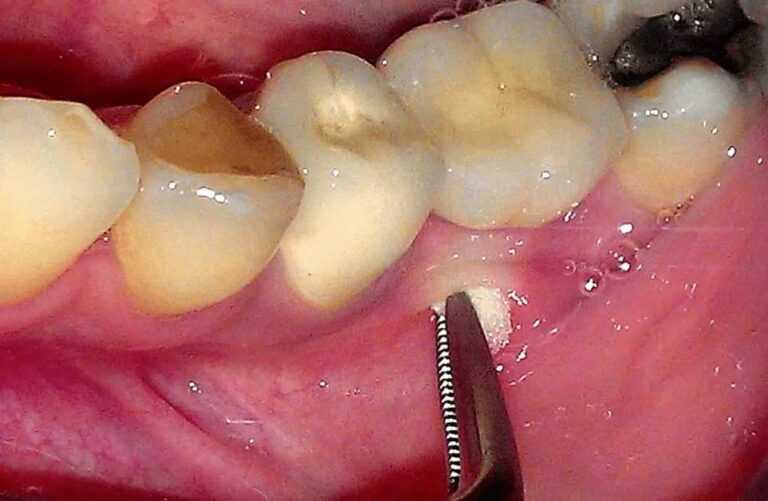
Without treatment, advanced caries continues to spread. Once bacteria and their toxins reach the pulp, pulpitis develops. The infection can then extend beyond the root, leading to periodontitis, swelling, or abscess formation. This is why even a painless deep cavity requires prompt examination by a dentist.
Symptoms of Advanced Dental Caries
The hallmark sign of advanced caries is a pronounced reaction of the tooth to various stimuli. Pain most commonly occurs when consuming cold, hot, sweet, or acidic food and drinks. It may be sharp in nature but typically resolves quickly once the stimulus is removed. If the pain lingers for an extended period or arises without any apparent cause, this may indicate pulp involvement and the onset of pulpitis.
Symptoms of advanced dental caries:
a visible cavity or defect in the tooth
darkened, softened dentine at the base of the cavity
food getting trapped between teeth or inside the cavity
bad breath
sensitivity or pain when chewing
a sensation that the tooth has become brittle or partially broken
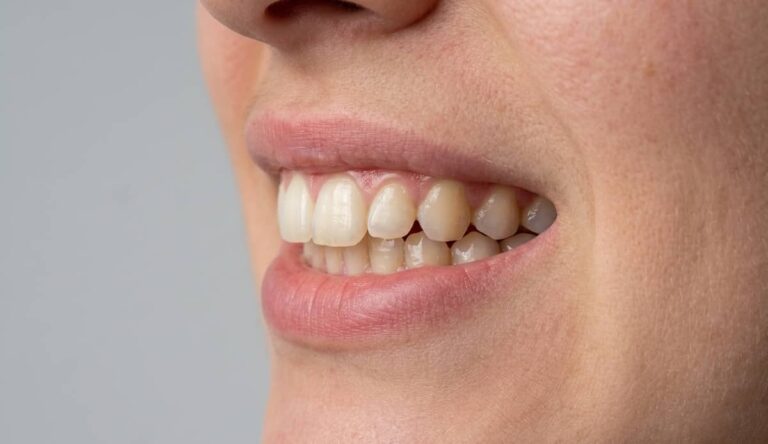
Sometimes a patient may notice tooth discolouration or an uneven enamel edge without experiencing significant pain. This is particularly characteristic of chronic caries, which can develop for a prolonged period with few or no obvious symptoms.
The absence of pain does not mean the tooth is healthy. Routine preventive check-ups with a dentist at least once every six months help to detect decay in its early stages and begin treatment before pulpitis, periodontitis, or other complications develop.
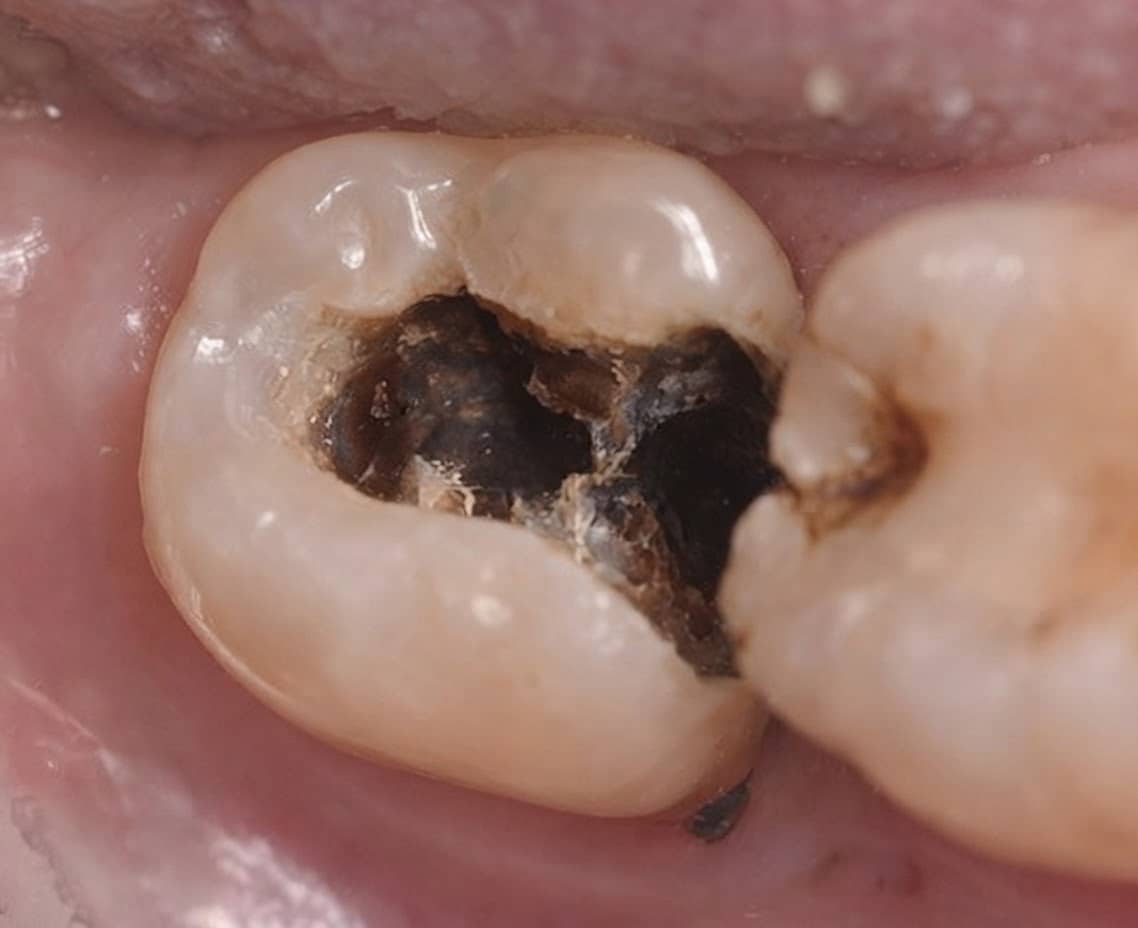
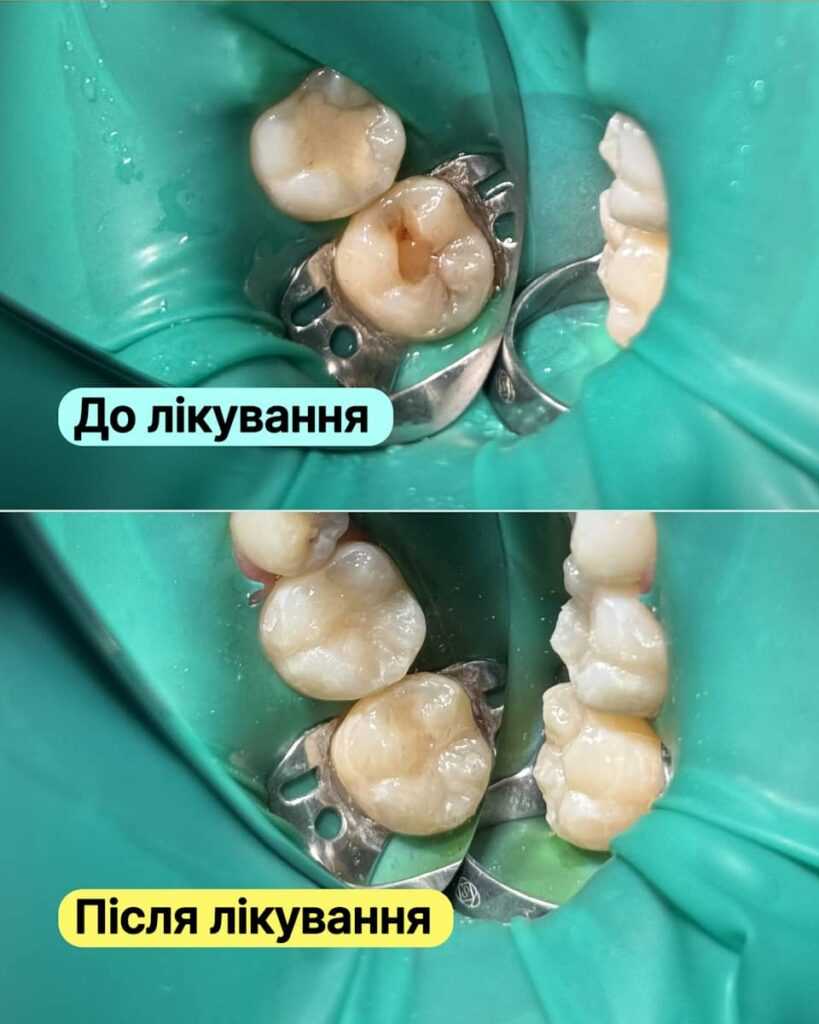
Patient’s Story 🦷 Treatment of Secondary Caries and Replacement of an Old Filling
📸 In the photo:
Before treatment — a damaged filling and secondary caries that developed underneath it.
After treatment — the tooth restored with a modern composite restoration that precisely reproduces its natural shape and chewing surface.
During treatment, the caries-affected tissues were removed and the old filling was replaced with a new composite restoration of tooth 4.6.
Timely replacement of damaged fillings helps stop the development of secondary caries, preserve healthy tooth tissues, and avoid more complex treatment in the future.
Primary (baby) teeth are considerably more susceptible to decay than permanent teeth. Their enamel is thinner and less mineralised, the dentine is less dense, and the pulp sits closer to the tooth surface. Because of these anatomical characteristics, tooth decay in children can progress very rapidly – in some cases, the time between a small spot and a deep cavity is surprisingly short.
Advanced caries in a child is not always accompanied by intense pain. The tooth may react to cold, heat, or sweetness, or cause discomfort during chewing – but sometimes there are no pronounced symptoms at all. This is why parents may only notice the problem once the tooth has been significantly damaged or the infection has already reached the pulp.
The common belief that baby teeth do not need to be treated because they will fall out anyway is a misconception. Early loss of a primary tooth can disrupt the alignment of neighbouring teeth, complicate the eruption of permanent teeth, and negatively affect the development of the bite. Furthermore, the infection can spread to surrounding tissues and to the germ of the permanent tooth underneath.
For this reason, even a small cavity in a child’s tooth warrants an examination by a paediatric dentist. The earlier treatment begins, the greater the chance of preserving the tooth, avoiding complications, and making the procedure quicker and more comfortable for the child.
How Advanced Caries Is Treated: Steps and Methods
Treatment of advanced dental caries is carried out under local anaesthesia, so the procedure is generally painless.
The dentist begins by cleaning the tooth of plaque and isolating the working area. The decayed tissue is then removed. With modern approaches, the dentist aims to preserve as much healthy dentine as possible – particularly when the cavity is situated very close to the pulp – in order to minimise the risk of accidentally exposing it.
Once the cavity has been cleaned, it is treated with antiseptic agents. Where necessary, a therapeutic or protective liner is applied to help shield the pulp and stimulate the formation of secondary dentine.
If sufficiently dense dentine remains after the removal of all decayed tissue, a permanent filling is placed in the same appointment. However, if the decay was very deep and there is a risk of pulp irritation, the dentist may place a medicated liner and a temporary filling first, with the final restoration completed at a follow-up visit.
If the infection has already reached the pulp and pulpitis or periodontitis has developed, a simple filling is no longer sufficient. In such cases, endodontic treatment is required – cleaning and filling of the root canals. This is precisely why it is so important to see a dentist before complications arise.
Complications and Prevention
Without treatment, advanced caries almost always continues to progress. Over time, bacteria reach the pulp and cause pulpitis, then spread beyond the root – potentially leading to periodontitis, abscess, soft tissue swelling, and even tooth loss. If the destruction of the crown is too extensive, restoring the tooth may no longer be possible.
The foundation of prevention is treating even minor cavities in a timely manner. To reduce the risk of developing advanced caries, the following is recommended:
brush teeth twice a day with fluoride toothpaste
floss regularly or use interdental brushes
limit frequent consumption of sweets and sugary drinks
maintain a balanced diet
attend preventive check-ups and professional oral hygiene appointments at least every six months
Seeking dental care promptly makes it possible to treat even advanced caries successfully, preserve the vitality of the pulp, and avoid the need for root canal therapy or tooth extraction.
Frequently Asked Questions (FAQ)
Is treatment of advanced caries painful?
Modern treatment is carried out under local anaesthesia, so patients typically experience no pain during the procedure.
Is the nerve always removed for advanced caries?
If inflammation has not yet reached the pulp, the dentist will aim to preserve the nerve. Root canal treatment is only necessary when the caries has already been complicated by pulpitis or another inflammatory process.
What should I do if my tooth is hurting and I can’t get to a dentist straight away?
If you are in pain and cannot see a dentist immediately, you may take an over-the-counter pain reliever if there are no contraindications, avoid very hot, cold, and sweet foods, and maintain thorough oral hygiene in the meantime.
Can advanced caries resolve on its own?
Tooth decay is an irreversible process – damaged tooth tissue does not regenerate on its own. Without treatment, the destruction will only continue to worsen.
How long does treatment take?
The duration of treatment depends on the depth of the decay and the condition of the pulp. When there are no complications, caries can often be treated in a single appointment lasting approximately 40-90 minutes. If staged treatment or root canal therapy is required, two or more visits may be necessary.
The author of this article is Kateryna Sazhneva, a pediatric dentist, general dentist, and medical director of the “Med-Deo” dental clinic chain.
 (044) 394 90 94
  Holosiivska/Demiivska metro station

















Your email will not be published on the site.