 (044) 394 90 94
 Holosiivska/Demiivska metro station


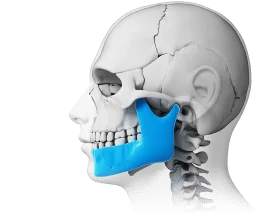








Patients often ask: “What is microcurrent TENS therapy in dentistry and will it work for me?“. We answer: TENS – if you decipher the abbreviation itself – it is short for Transcutaneous Electrical Nerve Stimulation. This is “transcutaneous electronic neurostimulation” – i.e. “stimulation of nerves through the skin”. Thanks to this TENS stimulation, the therapy allows you to anesthetize and relax the chewing muscles to a certain extent, and improve the work of the maxillofacial area.
It is important that in dentistry this method is part of a comprehensive approach. It can be used even before the main dental treatment of masticatory muscle and temporomandibular joint (TMJ) disorders. And his task here is to alleviate the symptoms, and after relaxing the muscles, help the doctor assess the position of the lower jaw.
How It Works
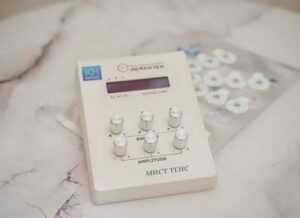
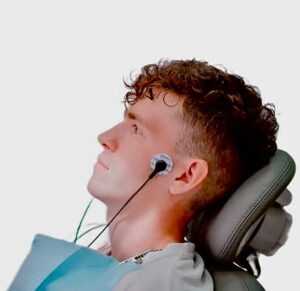
A TENS device generates low-frequency biphasic pulses—brief, mild electrical impulses in which the current alternates direction. Delivered via electrodes placed on the skin, these pulses stimulate the nerves, which in turn transmit signals to the muscles. This stimulation causes the muscle to undergo a process akin to a “massage”—alternating between contraction and relaxation. The patient perceives this simply as a rhythmic twitching of the muscles or a mild tingling sensation. This process can improve local blood circulation and accelerate the removal of lactic acid that accumulates in overstrained muscles. The result is muscle relaxation, allowing hypertonic (overly tense) masticatory muscles to gradually loosen.
Simultaneously, the perception of pain diminishes, and the body is prompted to produce more endorphins—its own natural painkillers.
IMPORTANT: The electrical current intensity and pulse frequency used during TENS therapy are not standardized settings. Specific parameters must be determined exclusively by a physician, based on the individual patient’s condition.
 TENS therapy may be recommended for various symptoms and conditions, but always following an examination by a physician. Therefore:
 TENS does not treat teeth, correct malocclusion, or replace primary gnatological or orthodontic treatment; rather, it is part of a comprehensive therapeutic approach. The benefits of TENS that assist during dental procedures include the following:
















Артем Гончаренко
2026-10-28
Через постійне напруження жувальних м'язів лікар запропонував пройти курс ТЕНС-терапії. Під час процедури відчувалися легкі імпульси, але болю не було. Після кількох сеансів помітив, що щелепа стала менш напруженою. Приємно, що лікування проходить комфортно і без поспіху.